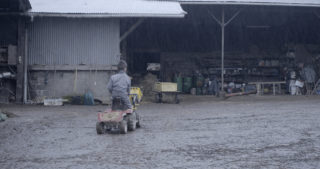
« Quatre rangées pas alignées, 37 visages tournés vers l’objectif du photographe. Automne 1958, une famille de paysans bretons en habit du dimanche, réunie autour des plus vieux. Bien présenter pour la photo. Vie modeste honnêtement gagnée par un travail laborieux». C’est ce que clame le narrateur au début du film, son regard campé dans le nôtre. La photo, prise à l’occasion de noces d’or des grands-parents du cinéaste est le déclencheur de Paysage ordinaire, et le symbole d’une manière de vivre aujourd’hui disparue. Un fil est créé entre 1958 et 2018, à partir d’un territoire, d’un espace dont l’évolution est liée à la terre et à son travail. De là, le film se déploie et cherche à reconstituer une mémoire commune. Par la parole d’abord, des témoignages de paysans devenus agriculteurs puis entrepreneurs agricoles, récoltés par bribes. Puis par l’image, grâce à cette caméra flottante, qui arpente les lieux à la recherche de quelque chose. Une trace ? Un souvenir ? Alors que le rural n’est plus un paysage habité mais traversé, quel est notre ancrage à la terre ?
Madeline Robert
“Four unaligned rows, 37 faces turned towards the camera lens. Autumn 1958, a family of Breton peasants in their Sunday best, gathered around the eldest. Smartly dressed for the photo. A modest living honestly earned by laborious work”. This is what the narrator proclaims at the beginning of the film, leading us to see things through his eyes. The photo, taken on the occasion of the golden wedding anniversary of the director’s grandparents, is the catalyst of Ordinary Landscape and the symbol of a way of life that is now gone. A thread is created between 1958 and 2018, starting with a territory, a space whose evolution is linked to the earth and working it. From there, the film unfurls and seeks to reconstitute a shared memory. Through words at first, from testimonies of peasants who became farmers and then agricultural entrepreneurs, harvested in fragments. Then through images, thanks to a floating camera, which roams the locations in search of something. A trace? A memory? In what ways are we anchored to the earth, when the rural environment is no longer a landscape that is inhabited but merely one that is crossed?
Madeline Robert
«Vier ungerade Reihen, 37 Gesichter, die dem Objektiv des Fotografen zugewandt sind. Herbst 1958. Eine bretonische Bauernfamilie umgibt im Sonntagsgewand die Familienältesten. Auf dem Foto möchte man gut aussehen. Ein bescheidenes Leben, das man sich durch harte Arbeit redlich verdient hat». Das behauptet der Erzähler, der uns in die Augen sieht, zu Beginn des Films. Das Foto, das anlässlich der goldenen Hochzeit der Grosseltern des Regisseurs aufgenommen wurde, ist der Auslöser für Ordinary Landscape und Symbol einer inzwischen verschwundenen Lebensweise. Ausgehend von einem Gebiet, einem Raum, dessen Entwicklung mit dem Land und seiner Bewirtschaftung verbunden ist, wird eine Brücke zwischen 1958 und 2018 geschlagen, die der Film als Ausgangspunkt für den Versuch nutzt, ein gemeinsames Gedächtnis zu rekonstruieren. Den Anfang macht das Wort mit den in Satzfetzen geernteten Erzählungen von Bauern, die erst Landwirte, dann landwirtschaftliche Unternehmer wurden. Dann folgt das mit schwebender, sich suchend durch die verschiedenen Orte bewegender Kamera eigefangene Bild. Eine Spur? Eine Erinnerung? Wie ist es um unsere Verwurzelung mit der Erde bestellt, wenn ländliche Gebiete nicht mehr bewohnt, sondern durchquert werden?
Madeline Robert
Damien Monnier
Maud Martin
Sylvie Plunian